
Abstract
BACKGROUND/AIMS
To determine the gender distribution of authors and the change in this distribution between 2000 and 2022 in review articles published in the ophthalmology literature.
MATERIALS AND METHODS
The PubMed database was scanned using “Review”, “Systematic Review”, and “Meta-Analysis” as filters. Articles published in 71 major ophthalmology journals between 2000 and 2022 were included in the study. Genders of the first and last authors, and the countries of their institutions were extracted using the gender application program interface (https://gender-api.com) and MATLAB data analysis software.
RESULTS
A total of 16,711 review articles were published from 2000-2022, and 64,419 authors were evaluated within the scope of our study. Of these, 5,578 (33.4%) first authors and 4,081 (24.5%) last authors were female. In 2000, 8.6% of first authors and 6.0% of last authors were women. By 2022, this percentage had increased to 39.8% and 30.6%, respectively. The increasing trends in the rate of females becoming both first and last authors were statistically significant, and the difference between the slopes of the regression curves by analysis of covariance was so as well (R=0.861, p<0.001 for first authors and R=0.781, p<0.001 for last authors, respectively). In addition, there was a significant relationship between the gender identity of the first and last authors (p<0.001).
CONCLUSION
Our study reveals a trend towards resolving gender inequality in the field of ophthalmology. This novel finding is encouraging; however, we believe these developments are insufficient.
Keywords: Gender, gender disparity, authorship, ophthalmology, review
INTRODUCTION
Throughout the world, women may face unfair and unequal treatment simply because of their gender due to social prejudices and conservative perspectives. Unfortunately, the female gender still poses an obstacle to professional and academic progress in the medical field. However, recent studies present promising results, that reveal this situation is changing for the better in the field of medicine, especially in ophthalmology. In a study conducted in 2019 for the first time in the history of the United States (US), the rate of female students exceeded the rate of male students, reaching 50.5%. In addition, the proportion of female ophthalmology residents increased from 25% in 2017 to 41%.-
Despite these encouraging developments, 90% of department chairs of ophthalmology remain male, and just 28.0% of ophthalmology faculty members are women., Although there has been an increase in the proportion of female ophthalmology doctors in recent years, the proportion of women editors in ophthalmology journals still lags significantly., Moreover, in ophthalmology publications, female authors are considerably less than male authors.- Revealing this gender inequality and understanding its causes is crucial in changing the current situation and ensuring gender equity.
Despite publications examining gender inequality among major ophthalmology journals, and more comprehensive publications examining many such journals, in the literature, none of these has examined review articles.- Review articles are typically invited, and such invitations are limited to prominent names in the field and prestigious positions in the clinic, both of which are dominated by males. Thus, for the first time, in the current study, we specifically aimed to show the gender distribution of authors and the change in this distribution over time in review articles published in the ophthalmology literature between 2000 and 2022. We believe that examining review articles is imperative to truly understand gender inequity in the ophthalmology field.
MATERIALS AND METHODS
The PubMed database was scanned using the selected filters: “Review”, “Systematic Review”, and “Meta-Analysis”. Articles published in 71 major ophthalmology journals, with the highest impact factor according to Web of Science metrics, between 2000 and 2022 were included in the scope of the study ().
MATLAB (version R2020a) (MathWorks, Natick, MA) was used to download articles from PubMed. Using the program, the names of the first and last authors and the countries of their institutions were determined, and the total numbers of authors and articles were evaluated. The Gender application program interface (API) (https://gender-api.com) was used to determine the genders of first and last authors based on their first names. Gender-API returns female, male, or undetermined for each given first name. This algorithm is the most accurate gender assignment program with over 98% accuracy. Authors with unknown gender were excluded. When only one author was listed, they were assigned to the first author cohort and excluded from the last author group.,
Statistical Analysis
Statistical analyses were conducted using IBM SPSS Statistics (version 28.0). Descriptive statistics, including the mean ± standard deviation, median (interquartile range), and median (minimum-maximum), are presented in terms of frequency distributions. The assumption of normal distribution of data was tested by the Kolmogorov-Smirnov test. Independent sample t-tests were performed for comparison of the data. Relationships between authors’ genders were examined with Pearson’s chi-squared test. Linear regression analysis was used to examine the trend in the proportion of female authors over the years. The slope of the regression curves was compared by analysis of covariance (ANCOVA). The significance level was considered at 0.05 in the analyses, and results with p<0.05 were interpreted as statistically significant.
RESULTS
A total of 17,225 review articles with 64,419 authors, published between 2000 and 2022, were evaluated within the scope of our study. The gender of the first author was assigned in 16,711 articles, where it was determined that only 5,578 (33.4%) of the first authors were female. Of the 16,669 review articles in which the gender of the last author could be determined, only 4,081 (24.5%) last authors were female.
As shown in , 51.4% of first authors were male if the last author was female, but only 28.2% of first authors were female if the last author was male. The relationship between the first and last authors’ genders of the articles was statistically significant (p<0.001).
Table 1. Relationship between the first and last authors’ gender
Gender of first author | Gender of last author | p | |
Male | Female | ||
Male | 8,853 (71.8%) | 2,054 (51.4%) | <0.001* |
Female | 3,480 (28.2%) | 1,942 (48.6%) | |
*Pearson chi-square test.
In addition, when we compared the average number of authors based on the gender of the first author, we found that the average number of authors in publications with male first authors (3.6±2.8) is statistically significantly lower than that in those with female first authors (4.0±3.0) (p=0.02).
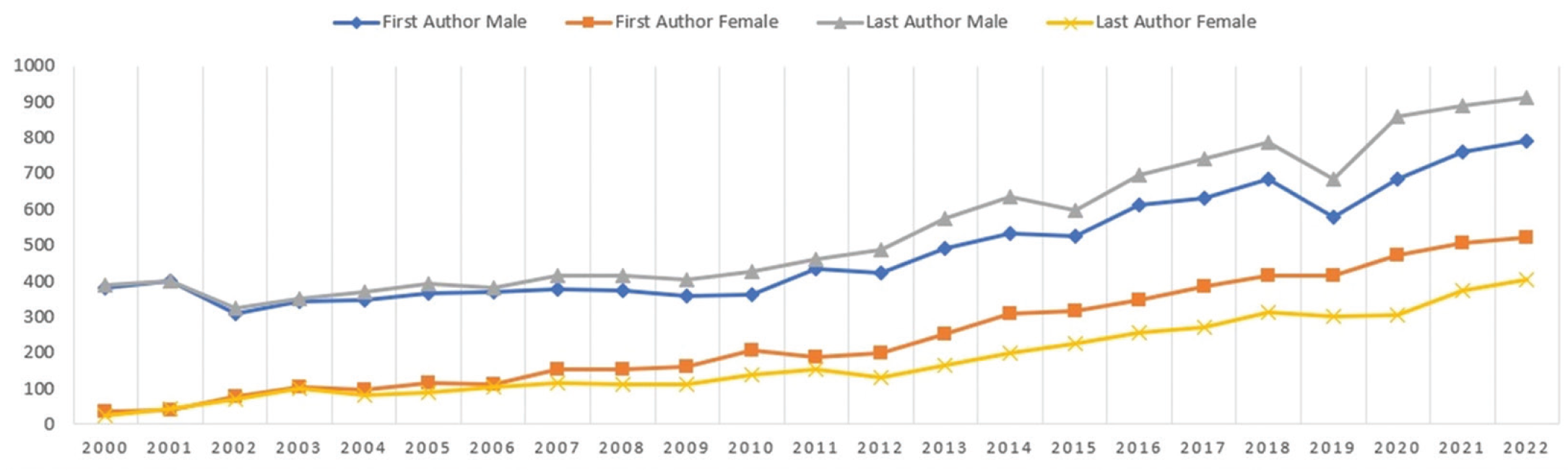
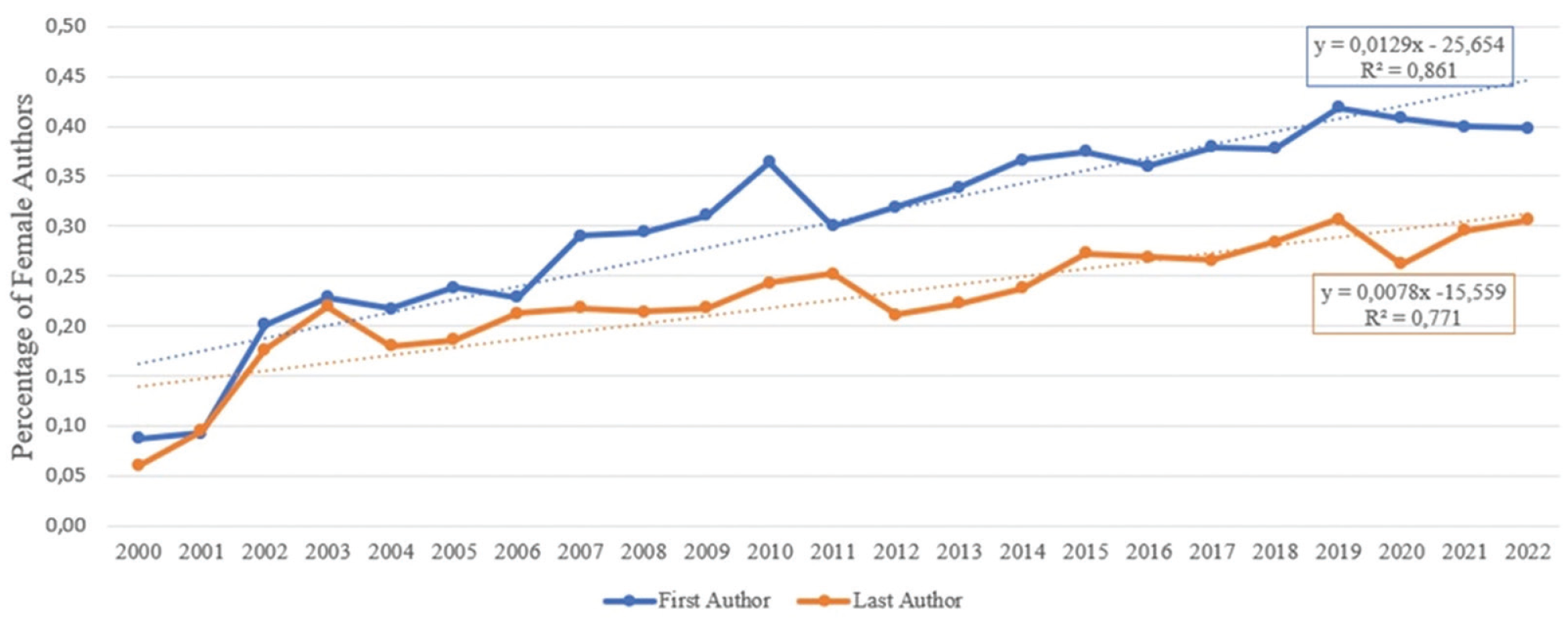
When the distribution of authors by gender was examined over time, we found an increase in the number of first and last female authors in parallel with an increase in the number of publications. While the rate of females becoming first authors was 8.6% in 2000, this rate has increased over the years and reached 39.8% in 2022. When gender distributions were examined by the last authors, the proportion of females increased from 6.0% in 2000 to 30.6% in 2022 ().
The increasing trends in the numbers of females as both the first author and the last author are statistically significant, and there is a significant difference between the slopes of the regression curves (R=0.861, p<0.001, and R=0.781, p<0.001, respectively, ANCOVA) ().
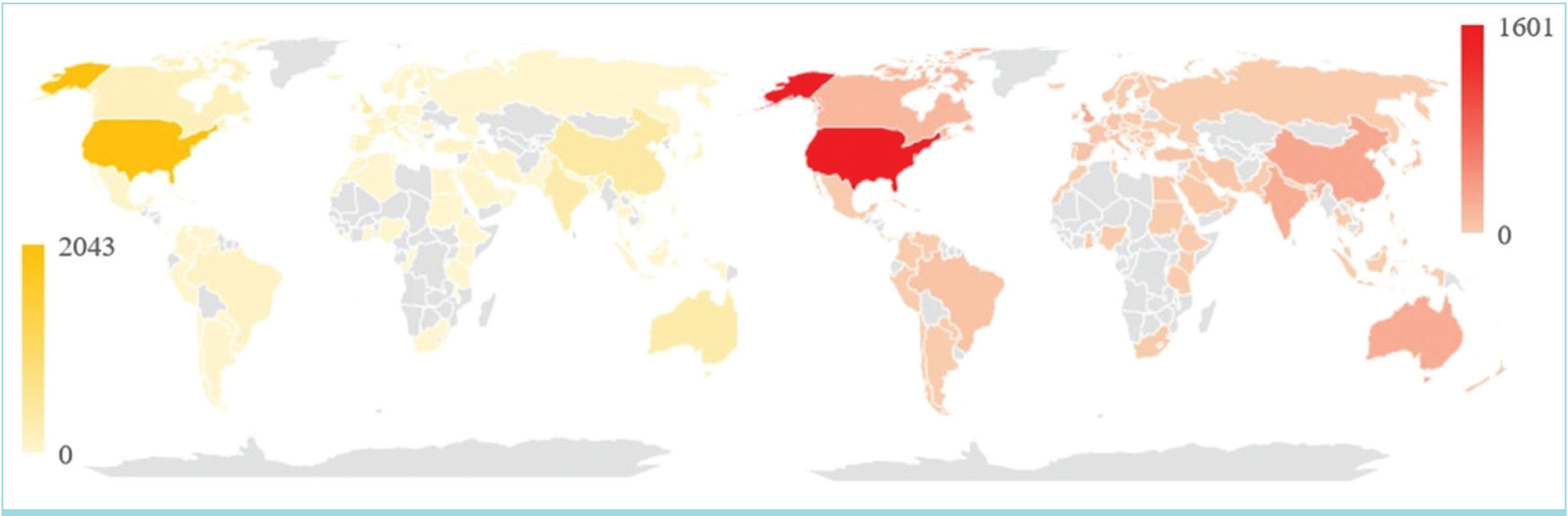
The five countries that published the most review articles with female first and last authors and the highest proportion of female authors are shown in , . Considering both the total number of authors and the number of female authors, the US ranked first, and the United Kingdom (UK) ranked second regarding the number of first and last authors. Although Chinese and Indian institutions published fewer ophthalmology review articles, these reviews had a slightly higher female-to-male gender ratio for the first and last authors than reviews from the US and the UK.
Table 2. Top 5 countries list by number of the first and last female authors
Country | Article count, (n) | Female first author, (n, %) | Article count, (n) | Female last author, (n, %) |
|---|---|---|---|---|
United States | 6,176 | 2,043 (33.1%) | 6,378 | 1,601 (25.1%) |
United Kingdom | 1,470 | 431 (29.3%) | 1,513 | 295 (19.5%) |
China | 1,053 | 413 (39.2%) | 960 | 279 (29.1) |
Australia | 934 | 329 (35.2%) | 956 | 241 (25.2) |
India | 831 | 325 (39.1%) | 794 | 228 (28.7) |
DISCUSSION
Women face many inequalities in both their social and professional lives in almost every country in the world simply because of their gender. Unfortunately, this remains an issue for female doctors. Especially in surgical specialties such as ophthalmology, women’s professional advancement is hindered because of both the demanding working conditions and the historically male-dominated hierarchy.
Despite promising findings indicating increased women’s dominance in ophthalmology, studies from 2019 and 2021 in the US revealed that professional women’s expectations for promotion are significantly lower than those of men., Although there are many reasons for this, the most important reasons may include the continued male dominance in leadership positions, an inability to find female mentors, ongoing male gender-related pressures in surgical specialties, a bias towards hiring men, and the demands of child care necessitating time away from the clinic.-As a woman, one needs tremendous effort to progress in a field that requires sustained practice and productivity over an extended period to become a skilled surgeon or to advance as an academic. However, despite these difficulties, studies show that women are more considerate and accommodating than men. Many studies conducted between 1989 and 2014 demonstrate that women prioritise patient care and trainees’ education, over academic progress, and consider their family and social responsibilities equally important to their progress in their professional lives.- In addition, a 2011 study by Reed et al. shows that women’s academic production increases significantly after the early stages of their professional lives. Unfortunately, the demands of surgical and academic life cause this accommodating attitude of women to hinder their professional advancement. Many current studies examining gender inequality in the ophthalmology literature have found promising results indicating that the number and proportion of female authors are increasing.- These studies that evaluated changes in first and last author genders over time were conducted using similar methods to our study. Although the studies show that the number and ratio of female to male both first and last authors are increasing, the increase in the ratio of female to male last authors is significantly lower than the increase in the ratio of female to male first authors in all studies. In addition, two comprehensive studies that scanned publications from 2000-2009 and from 2015-2019 showed a significant correlation between the gender of the first and last author. The number of publications in which both the first and last author were male was significantly higher than those with female first and last authors.,
Typically, the first authors are young physicians, whereas the last authors usually hold senior positions in the clinic, are established in the field, and are predominantly male. Consistent with this, studies investigating gender inequality in the ophthalmology literature revealed that, although the increase in the proportion of female first authors is encouraging, the change in the proportion of female last authors is less impressive. Our study was based on the assumption that writing an ophthalmology review article requires a journal invitation and experience, i.e., working in the field for a long time and holding a leadership position in the clinic. Thus, to further our understanding of gender inequality in the field of ophthalmology, we specifically analyzed the authorship gender trends of review articles from 2000 to 2022. We evaluated 17,225 articles written by 64,419 authors, published in 71 major ophthalmology journals, and found that the percentage of female first authors was 33.4%, similar to previous results in the literature, whereas that of female last authors was only 24.5%. In addition, we detected a high degree of correlation between male individuals serving as both first and last authors. However, the fact that we identified a statistically significant increase in the proportion of female authors from below 10% on average in 2000 to over 30% in 2022 gives us hope. Despite the significantly increasing number of female ophthalmologists, as reflected by the increase in the number of female authors of review articles, the high percentage of male clinical leaders and journal editors indicates continued bias and inequality. In addition, the fact that articles with female first authors included more authors overall, articles with female last authors more often have male first authors, shows that the accommodating attitude of women continues despite all the difficulties they experience. If this injustice persists for ophthalmologists, who are among the most intelligent and hard-working individuals, receive the highest level of education, and as professionals, communicate with all segments of society, it is clear that gender inequity desperately needs to be addressed at all levels of society.
Study Limitations
Our study had several limitations: It was limited to accessible articles, and those articles not in online indexes could not be evaluated. Our study only included articles from 2000; data older than that were left unanalysed. Owing to the study design and the lack of analyses, such as the independent and comparative evaluation of general ophthalmology journals and subspecialty specific ophthalmology journals, we could not draw any firm conclusions about the significance of the prevalence and correlations described. Moreover, the fact that the proportion and number of women working in ophthalmology clinics are not known exactly may have caused incomplete evaluation of our results. Although our study excluded publications in which we could not determine the gender of the authors from their first and last names, our results are similar to those published in the literature. However, if the author changed their last name during the academic career, they might be considered two different authors and may have caused errors in our results. In addition, scanning articles from various countries may have caused our results to be affected by economic and cultural differences.
CONCLUSION
In conclusion, we believe that our results are crucial because our study is the first to specifically examine the gender of authors of review articles in the ophthalmology literature, as well as the changes in gender over the past two decades. Although the results of our study revealed promising developments regarding gender equality in the field of ophthalmology, we believe that more progress is required. We conclude that our study yields clinically important results that may serve as the basis for further studies in this field.
MAIN POINTS
• Review articles are typically invited, and such invitations are limited to prestigious individuals and prestigious clinical positions, both of which are dominated by males.
• In the current study, we specifically aimed to show the gender distribution of authors and the change in this distribution over time in review articles published in the ophthalmology literature between 2000 and 2022, considering that examining these articles is imperative for understanding gender inequity in the ophthalmology field.
• Although the results of our study revealed promising developments regarding gender equality in the field of ophthalmology, we believe that more progress is required.
ETHICS
Ethics Committee Approval: Not applicable.
Informed Consent: Not applicable.
Financial Disclosure: The author declared that this study had received no financial support.
Footnotes
Ethics
Ethics Committee Approval: Not applicable.
Informed Consent: Not applicable.
Financial Disclosure: The author declared that this study had received no financial support.
References
Applicant F. Matriculant, and enrollment data tables. AAMC. 2019; 15(2022): 2019-12.
Fairless EA, Nwanyanwu KH, Forster SH, Teng CC. Ophthalmology departments remain among the least diverse clinical departments at United States Medical Schools. Ophthalmology. 2021; 128(8): 1129-34.
Tirumalai AA, George EL, Kashikar A, Langston AH, Rothenberg KA, Barreto NB, et al. Gender disparity in surgical society leadership and annual meeting programs. J Surg Res. 2021; 266: 69-76.
Shah DN, Volpe NJ, Abbuhl SB, Pietrobon R, Shah A. Gender characteristics among academic ophthalmology leadership, faculty, and residents: results from a cross-sectional survey. Ophthalmic Epidemiol. 2010; 17: 1-6.
Kloosterboer A, Yannuzzi NA, Gedde SJ, Sridhar J. Residency program directors of United States ophthalmology programs: a descriptive analysis. Am J Ophthalmol. 2020; 209: 71-6.
Mansour AM, Shields CL, Maalouf FC, Massoud VA, Jurdy L, Mathysen DG, et al. Five-decade profile of women in leadership positions at ophthalmic publications. Arch Ophthalmol. 2012; 130(11): 1441-6.
Morton MJ, Sonnad SS. Women on professional society and journal editorial boards. J Natl Med Assoc. 2007; 99(7): 764-71.
Mimouni M, Zayit-Soudry S, Segal O, Barak Y, Nemet AY, Shulman S, et al. Trends in authorship of articles in major ophthalmology journals by gender, 2002-2014. Ophthalmology. 2016; 123: 1824-8.
Shah DN, Huang J, Ying GS, Pietrobon R, O’Brien JM. Trends in female representation in published ophthalmology literature, 2000-2009. Digit J Ophthalmol. 2013; 19: 50-5.
Kalavar M, Watane A, Balaji N, Cavuoto KM, Vanner EA, Kuriyan A, et al. Authorship gender composition in the ophthalmology literature from 2015 to 2019. Ophthalmology. 2021; 128(4): 617-9.
Gervasio KA, Sklar BA, Nguyen AX, Wu AY. Gender authorship trends in the ophthalmic plastic and reconstructive surgery literature. Ophthalmic Plast Reconstr Surg. 2022; 38(2): 160-5.
Cao S, Xiong Y, Zhang W, Zhou J, He Z. The extent of gender gap in citations in ophthalmology literature. Front Med (Lausanne). 2022; 9: 855385.
Chien JL, Wu BP, Nayer Z, Grits D, Rodriguez G, Gu A, et al. Trends in authorship of original scientific articles in Journal of Glaucoma: an analysis of 25 years since the initiation of the journal. J Glaucoma. 2020; 29(7): 561-6.
Kramer PW, Kohnen T, Groneberg DA, Bendels MHK. Sex disparities in ophthalmic research: a descriptive bibliometric study on scientific authorships. JAMA Ophthalmol. 2019; 137(11): 1223-31.
Kalavar M, Watane A, Patel MM, Sridhar J, Cavuoto KM. Gender representation in pediatric ophthalmology: an analysis of trends over a decade. J AAPOS. 2020; 24(6): 340.e1-5.
Heng Wong MY, Tan NYQ, Sabanayagam C. Time trends, disease patterns and gender imbalance in the top 100 most cited articles in ophthalmology. Br J Ophthalmol. 2019; 103(1): 18-25.
Nielsen MW, Andersen JP, Schiebinger L, Schneider JW. One and a half million medical papers reveal a link between author gender and attention to gender and sex analysis. Nat Hum Behav. 2017; 1(11): 791-6.
Santamaría L, Mihaljević H. Comparison and benchmark of name-to-gender inference services. PeerJ Comput Sci. 2018; 4: e156.
Mizgala CL, Mackinnon SE, Walters BC, Ferris LE, McNeill IY, Knighton T. Women surgeons. Results of the Canadian population study. Ann Surg. 1993; 218(1): 37-46.
Tsui I. The glass ceiling in ophthalmology-next comes how to change this. JAMA Ophthalmol. 2019; 137(11): 1231-2.
Berrocal AM. Women in ophthalmology : a comprehensive guide for career and life. In: Weng CY (eds). Cham, Switzerland: Springer Nature; 2021; p. 335-48.
Hamel MB, Ingelfinger JR, Phimister E, Solomon CG. Women in academic medicine--progress and challenges. N Engl J Med. 2006; 355(3): 310-2.
Jagsi R, Griffith KA, Stewart A, Sambuco D, DeCastro R, Ubel PA. Gender differences in the salaries of physician researchers. JAMA. 2012; 307(22): 2410-7.
Pololi LH, Civian JT, Brennan RT, Dottolo AL, Krupat E. Experiencing the culture of academic medicine: gender matters, a national study. J Gen Intern Med. 2013; 28(2): 201-7.
Carr PL, Ash AS, Friedman RH, Scaramucci A, Barnett RC, Szalacha L, et al. Relation of family responsibilities and gender to the productivity and career satisfaction of medical faculty. Ann Intern Med. 1998; 129(7): 532-8.
Reed DA, Enders F, Lindor R, McClees M, Lindor KD. Gender differences in academic productivity and leadership appointments of physicians throughout academic careers. Acad Med. 2011; 86(1): 43-7.
Levinson W, Tolle SW, Lewis C. Women in academic medicine. Combining career and family. N Engl J Med. 1989; 321(22): 1511-7.
Lopez SA, Svider PF, Misra P, Bhagat N, Langer PD, Eloy JA. Gender differences in promotion and scholarly impact: an analysis of 1460 academic ophthalmologists. J Surg Educ. 2014; 71(6): 851-9.
Supplementary Materials
Supplementary Table 1. Journals reviewed in alphabetical order
1. Acta Ophthalmologica |
|---|
2. Advances in Ophthalmology |
3. American Journal of Ophthalmology |
4. Annals of Eye Science |
5. Annual Review of Vision Science |
6. Arquivos Brasileiros de Oftalmologia |
7. Asian Journal of Ophthalmology |
8. Asia-Pacific Journal of Ophthalmology |
9. BMC Ophthalmology |
10. BMJ Open Ophthalmology |
11. Canadian Journal of Ophthalmology |
12. Chinese Journal of Ophthalmology |
13. Clinical and Experimental Ophthalmology |
14. Clinical Experimental Optometry |
15. Clinical Ophthalmology |
16. Contact Lens & Anterior Eye |
17. Cornea |
18. Current Eye Research |
19. Current Ophthalmology Reports |
20. Current Opinion in Ophthalmology |
21. Documenta Ophthalmologica |
22. European Journal of Ophthalmology |
23. Experimental Eye Research |
24. Eye |
25. Eye & Contact Lens |
26. Eye and Vision |
27. Graefe’s Archive for Clinical and Experimental Ophthalmology |
28. Indian Journal of Ophthalmology |
29. International Journal of Ophthalmology |
30. International Journal of Ophthalmology |
31. International Journal of Retina and Vitreous |
32. International Ophthalmology |
33. International Ophthalmology Clinics |
34. Investigative Ophthalmology and Visual Science |
35. JAMA Ophthalmology |
36. Japanese Journal of Ophthalmology |
37. Journal of Cataract and Refractive Surgery |
38. Journal of Current Ophthalmology |
39. Journal of Eye Movement Research |
40. Journal of Glaucoma |
41. Journal of Ocular Pharmacology and Therapeutics |
42. Journal of Ophthalmic Inflammation and Infection |
43. Journal of Ophthalmic Vision Research |
44. Journal of Ophthalmology |
45. Journal of Refractive Surgery |
46. Journal of the American Association for Pediatric Ophthalmology and Strabismus |
47. Journal of Vision |
48. Korean Journal of Ophthalmology |
49. Middle East African Journal of Ophthalmology |
50. Molecular Vision |
51. Ocular Immunology and Inflammation |
52. Ocular Surface |
53. Oman Journal of Ophthalmology |
54. Ophthalmic Epidemiology |
55. Ophthalmic Genetics |
56. Ophthalmic Plastic and Reconstructive Surgery |
57. Ophthalmic Research |
58. Ophthalmic Surgery, Lasers Imaging Retina |
59. Ophthalmologica |
60. Ophthalmology |
61. Ophthalmology and Therapy |
62. Optometry and Vision Science |
63. Orbit |
64. Pakistan Journal of Ophthalmology |
65. Perception |
66. Progress in Retinal and Eye Research |
67. Retina |
68. Seminars in Ophthalmology |
69. Survey of Ophthalmology |
70. The British Journal of Ophthalmology |
71. Turkish Journal of Ophthalmology |